
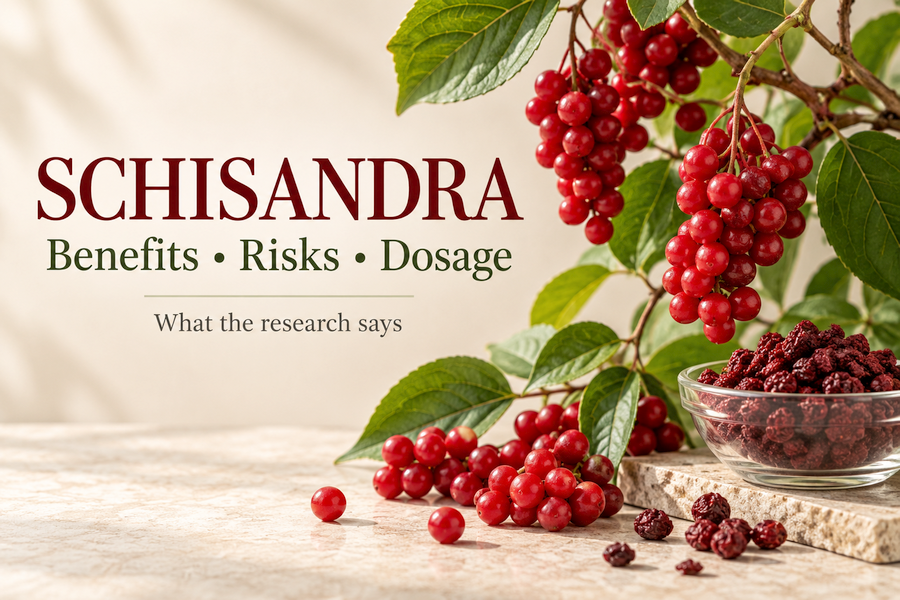
Schisandra is a tart berry used in traditional East Asian medicine. Small human studies suggest its extract may ease some menopause symptoms and possibly support muscle strength, but most claims about stress, focus, and liver health need better evidence. There’s no proven dose for general wellness. It can interact with medicines, especially the transplant drug tacrolimus, so check with a clinician before using it. (1–4)
Schisandra has one of the best nicknames in the herbal world: the “five-flavor berry.” Its Chinese name, wu wei zi, reflects a traditional description of the fruit as sour, sweet, bitter, salty, and pungent. You’ll find it as dried berries, tea, powders, capsules, and concentrated extracts. The plant most often discussed in supplements is Schisandra chinensis, though another species, S. sphenanthera, also appears in research. (1)
People often call schisandra an adaptogen, meaning an herb claimed to help the body cope with stress. That sounds appealing after a long week. Still, a traditional label isn’t proof that a supplement will improve your energy or calm your mind. Let’s look at what the studies can actually tell us. If you’re exploring the broader category, our guide to adaptogens for stress offers more context.
What’s in schisandra?
Schisandra contains plant compounds called lignans, including schisandrin and related substances. In lab and animal experiments, some of these compounds affect antioxidant systems, inflammation, and how the liver processes chemicals. Those findings help researchers decide what to study next. They don’t tell us that drinking berry tea will reproduce the same effects in a person. (1, 5)
There’s another wrinkle: a whole berry, a water-based tea, and a concentrated extract aren’t interchangeable. Different species and processing methods may change the mix of compounds. Keep that in mind when a product cites a study but doesn’t say whether its ingredients match what the researchers tested. (1, 5)

Potential benefits: What does the evidence show?
Menopause symptoms
This is one of schisandra’s more interesting areas of human research. In a small placebo-controlled trial, 36 women completed a study of a S. chinensis extract. The schisandra group showed a greater improvement on an overall menopause symptom scale over time. Hot flashes, sweating, and palpitations appeared to respond particularly well. (2)
Encouraging? Yes. Settled science? Hardly. One small trial can’t show how well the herb works across different people or whether the results last. A review also found that the study didn’t show a clear benefit for symptoms such as nervousness and depression. If hot flashes disrupt your sleep or daily life, it’s worth discussing treatments with a healthcare professional rather than relying on a berry supplement alone. (2, 6)
Muscle strength and fatigue
Another placebo-controlled study assigned 45 postmenopausal women to take either 1,000 mg of schisandra extract or a placebo daily for 12 weeks. The extract group improved on a test of thigh muscle strength, and resting blood lactate fell. Muscle mass and most other measures of physical performance didn’t clearly improve. (3)
That’s a narrow finding, not evidence that schisandra boosts gym performance or treats ongoing fatigue. The participants were all women in a specific age group, and the researchers didn’t closely track diet or physical activity during the trial. If you’re tired much of the time, the reason may need attention before you try a supplement. Our article on supplements for chronic fatigue looks at that bigger picture. (3)
Liver health
Schisandra has a long history of use for liver-related concerns, and early research has raised some intriguing questions. A review of schisandra-derived medicines used in China reported improvements in certain blood markers associated with drug-related liver injury. Yet the authors called for higher-quality clinical studies. Memorial Sloan Kettering Cancer Center likewise describes human liver studies as too limited to establish a clear benefit. (1, 7)
A lower liver enzyme number can be useful information, but it doesn’t prove that an over-the-counter schisandra capsule prevents or treats liver disease. Some studies used specialized preparations or combined treatments, which makes the results harder to apply to a standard supplement. If you have abnormal liver tests, get them evaluated instead of trying to “fix” the number yourself. For a broader discussion, see our liver support supplements guide. (1, 7)
Stress, focus, and antioxidant claims
Here the gap between marketing and evidence gets wider. Lab and animal findings suggest possible effects on inflammation, the nervous system, and physical endurance. A small cognitive study used a blend that included schisandra, so any effect couldn’t be assigned to schisandra alone. We still lack convincing human evidence that the berry by itself reliably improves focus, sleep, resilience, or everyday energy. (1)
You might feel better while taking it, of course. Expectations, changes in sleep, and what else is in a supplement can all play a role. That doesn’t make your experience imaginary; it just makes cause and effect difficult to pin down. The same caution applies to broad “antioxidant” promises. A lab result isn’t a clinical outcome. You can read more about that distinction in our guide to what antioxidants do. (1, 5)

Risks and possible side effects
Schisandra has generally looked tolerable in the small human studies available, but that’s a limited safety record. Memorial Sloan Kettering notes no serious side effects in the research it reviewed; one small trial reported sleepiness and cold hands or feet in both the supplement and placebo groups. That means we can’t confidently blame schisandra for those symptoms. It also means we can’t say that years of daily use are safe. (1)
If a product upsets your stomach or seems to make you feel unwell, stop using it and check with a healthcare professional. Introduce only one new supplement at a time so you have a better chance of spotting a reaction. Avoid the temptation to double the serving because an herbal product feels mild; concentrated extracts can behave differently from a cup of tea.
Drug interactions deserve the most attention. Schisandra can affect systems that move or break down medicines, including P-glycoprotein and certain CYP enzymes. In a study of 12 healthy volunteers, an extract of S. sphenanthera substantially increased exposure to tacrolimus, a medicine used after organ transplantation. That’s a real human interaction, though the size of the effect shouldn’t be assumed for every schisandra product. (1, 4)
If you take tacrolimus, don’t add schisandra on your own. If you take other prescription medicines, ask your pharmacist or prescriber to review the exact product first, particularly when drug levels require careful control. Lab findings suggest interactions with additional medicines are possible, but we don’t know how often they matter in everyday use. Stopping schisandra can also change an interaction, so let your care team know about any changes. (1, 4)
Pregnancy and breastfeeding are other times to be cautious. There isn’t enough dependable safety evidence for concentrated schisandra products in these groups. Health Canada has specifically asked for more reproductive and developmental safety data before accepting a standardized fruit extract as an ingredient for foods meant for the general population. It makes sense to avoid supplement doses during pregnancy or nursing unless your care team advises otherwise. (8, 9)
Children and people with significant medical conditions should also get individualized advice. If you’re being treated for liver disease, in particular, an herb that may change liver test results or drug exposure deserves a conversation with your clinician. And tell your surgical team about every supplement you take before a procedure. (1, 9)

How much schisandra should you take?
There’s no established, evidence-based daily dose for general wellness, stress, or liver support. In the menopause trial, researchers studied a particular extract at 784 mg daily for six weeks. A separate muscle study used 1,000 mg of extract daily for 12 weeks. These numbers describe two research products; they aren’t universal recommendations, and they shouldn’t be converted directly into grams of dried berries or drops of tincture. (2, 3, 6)
If your clinician says schisandra is reasonable for you, follow the directions for the specific product and discuss the dose with them, especially if you take medication. Look for the full botanical name, the plant part used, the amount per serving, and whether it’s a single-ingredient extract or a blend. A label that says only “schisandra complex” makes it harder to judge what you’re getting.
Quality matters too. The NIH notes that independent quality seals can help check whether a supplement contains its stated ingredients and avoids certain contaminants. Such seals don’t prove that the herb works or that it’s safe for your situation. A simple product with a clear label is easier to discuss with your pharmacist than a dozen-ingredient “stress” blend. (9)
The takeaway
Schisandra is an interesting herb, and the early menopause and muscle-strength findings give researchers good reasons to keep studying it. Its reputation for liver protection, better focus, and stress relief goes further than the human evidence currently supports. Meanwhile, the tacrolimus interaction is a practical reason to take its safety seriously. (1–4)
If you’re considering it, start with your goal: What symptom are you hoping to change, and how will you tell whether it helped? Then check your medicines and medical history with a qualified clinician. That small bit of homework is more useful than chasing a bigger dose.
This article is for general information and isn’t a substitute for personalized medical advice.
- https://www.mskcc.org/cancer-care/integrative-medicine/herbs/schisandra
- https://pubmed.ncbi.nlm.nih.gov/27763802/
- https://pmc.ncbi.nlm.nih.gov/articles/PMC7177795/
- https://pubmed.ncbi.nlm.nih.gov/17506780/
- https://pmc.ncbi.nlm.nih.gov/articles/PMC6412213/
- https://e-jmm.org/DOIx.php?id=10.6118/jmm.21022
- https://pubmed.ncbi.nlm.nih.gov/31004881/
- https://www.canada.ca/en/health-canada/services/food-nutrition/supplemented-foods/list-permitted-food-ingredients/information-ingredients-foods/decision-schisandra-chinensis-fruit-extract.html
- https://ods.od.nih.gov/factsheets/WYNTK-Consumer/



Nutrition expert. Blog writer. Health enthusiast.
Read more about me…


